


One Device. Four Beauty Solutions.
Adaptive light delivery for contour care, visible pigment and tattoo ink — with one elegant pen and one simple dial.
AURA ONE changes the beam profile, pulse rhythm and delivery style for each routine. Broad light supports contour-focused care, while focused pulses are designed for visible pigment and tattoo ink.
Adaptive Light
Changes beam size, pulse rhythm and delivery pattern for the selected routine.
Broad Coverage
Wide, gentle delivery designed for BUST and GLUTE contour-care routines.
Focused Precision
Concentrated light patterns designed for visible pigment and tattoo-ink care.
One-Dial Control
Turn, select and start. The complete light preset loads automatically.
Couldn't load pickup availability

dicount


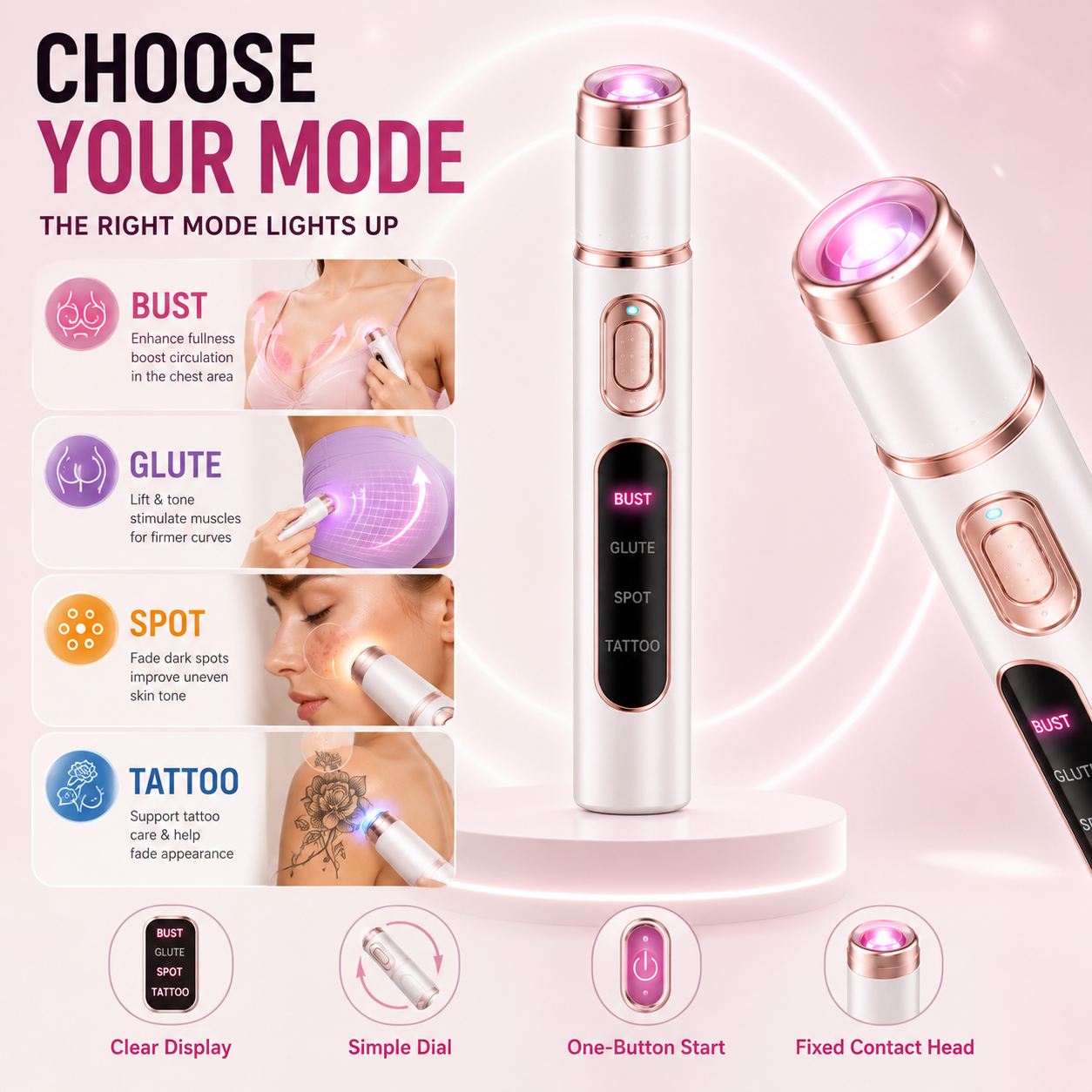

One handheld design. Four very different light routines.
AURA ONE combines broad, gentle light for contour-focused routines with concentrated pulses for visible pigment and tattoo ink. The dial does more than change a label—it loads a different beam shape, pulse rhythm, and session pattern.
Spreads energy across a larger area for BUST and GLUTE routines.
Concentrates light on smaller pigment or ink targets.
The selected routine lights up clearly on the pen.
The internal optics change the delivery pattern automatically.
Light can be delivered to support, heat, or fragment.
The same word “light” can describe very different effects. AURA ONE is built around three simple variables: how wide the beam is, how quickly it pulses, and how long it stays on the area.
A broad field covers contour areas; a small spot concentrates energy.
Gentle repeating light behaves differently from very short rapid pulses.
Moving across a larger area is different from treating one precise point.
Why this matters
Changing only the brightness would not create four useful routines. The optical profile and pulse behavior must change with the target.

The light meets a different target in each routine.
The product concept separates large-area tissue routines from small-area color routines. Tap each target to follow the intended action.
The rounded head spreads pressure and keeps the light source close to the selected area. The outer ring is designed to manage comfort and surface heat.
BUST and GLUTE use a wider, softer field intended to interact with local cellular activity and tissue condition without deliberately breaking pigment.
SPOT uses a smaller treatment point so light is concentrated where visible pigment is present, supporting gradual fragmentation and fading.
TATTOO uses a rapid pulse concept intended to break larger ink particles into smaller fragments that may fade progressively between sessions.

The contour routines aim for gradual tissue-level change.
BUST and GLUTE are not designed as instant fillers. Their concept is repeated, gentle light exposure intended to influence local cellular energy, tissue condition, and the way the area appears over time.
Cellular Energy Activity
Certain red and near-infrared light conditions have been studied for their interaction with mitochondrial activity—the energy system inside cells.
SPOT and TATTOO work by breaking color into smaller targets.
These routines use a smaller treatment point and shorter pulses. Their purpose is not to nourish tissue, but to concentrate energy where pigment or ink is present.

Concentrated pigment or tattoo ink absorbs light differently from the surrounding tissue. This creates the basis for selective targeting.
A short pulse delivers energy before heat has time to spread widely, creating a localized thermal or mechanical effect in the target.
The visible target is broken into smaller fragments. The immediate appearance may include darkening, frosting, redness, or temporary contrast.
The final change is progressive. Multiple sessions may be needed because not every pigment particle responds at the same time or depth.

What changes first—and what takes longer.
Different effects appear on different timelines. A temporary response should not be confused with a stable tissue or pigment change.
Immediately After Use
The area may feel warm or look slightly fuller from circulation and temporary fluid movement. Pigment routines may show redness, whitening, or darker contrast.
How to judge real change
Compare the same area under the same lighting and position. Stable change remains after warmth, redness, and temporary swelling have settled.

Simple outside. Purpose-built inside.
The product avoids app menus and interchangeable heads, but the internal system still has to change the optical delivery for each job.
A tactile click marks each routine so the selection can be felt as well as seen.
BUST, GLUTE, SPOT, or TATTOO appears directly on the product body.
The fixed head switches between a broad field and a smaller focused spot.
The selected program loads its own rhythm, timing, and session behavior.
Quiet background protection
Contact, temperature, timing, and output limits can operate automatically without adding extra steps to the interface.

Select the job. Then follow the matching movement.
The controls are the same, but broad contour routines use slow movement across an area, while focused pigment routines use precise point-by-point placement.
Step 1: Select the Routine
Turn the ring until the intended word lights up. Confirm the selected routine before placing the product on the skin.